A twelve person night on a six person table
The instinct is to find six more chairs. The better move is to stop treating the table as the party and start treating it as one of three places people can be.
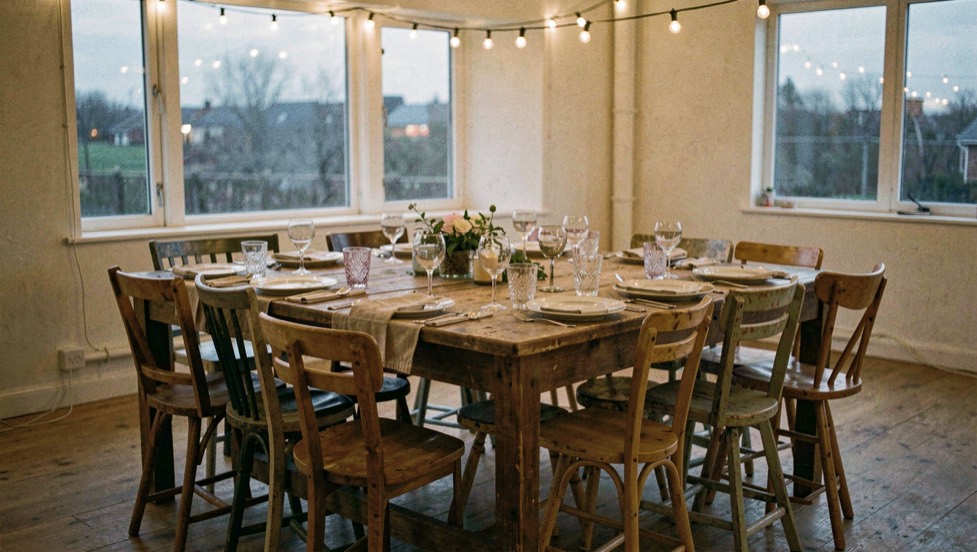
Twelve people in a room built for six is not a seating problem. It is a circulation problem wearing a seating problem's clothes, and every hour spent hunting for extra chairs is an hour spent making it worse, because chairs are the single largest consumer of floor space in any room.
Three zones, not one table
A room that holds twelve comfortably has three distinct places to be, and people move between them all evening.
- The seated core. Your table, with whatever it genuinely seats. Six is six. This is where people who want a long conversation end up, and it should be the calmest part of the room.
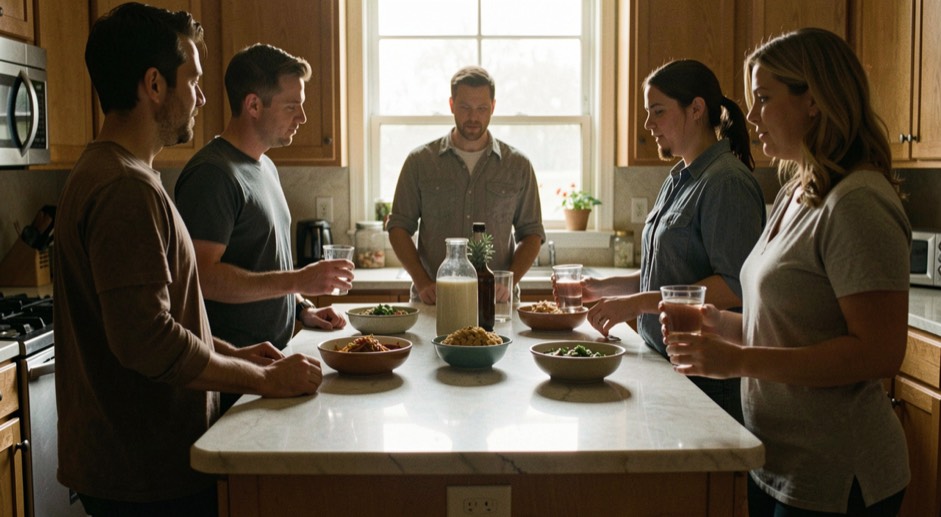
- The standing zone. A kitchen island, a high counter, a windowsill deep enough to put a glass on. Four to six people stand here and the composition changes constantly. This is where most of the party actually happens.
- The landing zone. A sideboard, a shelf, the top of a bookcase: somewhere at chest height where a person who is holding a drink and a plate can put one of them down. Without it, people hold everything all evening, and a person holding two things cannot gesture, eat or shake a hand.
The landing zone is the one everybody skips and it is the cheapest to create. A tray on top of a low bookcase is enough.
The loop
Leave 90 cm of clear passage between zones, and make sure the route from the door to the drinks to the food and back is a loop rather than a dead end. A room people can walk around never jams. A room with a single corridor into a corner jams within forty minutes, and the corner fills with four people who cannot get out.
Test it before anybody arrives by walking the route yourself carrying two glasses. Anywhere you have to turn sideways is a place two people will get stuck.
Seating maths
Allow 60 cm of table edge per person. A 180 cm table takes three a side, which is six, and putting somebody on each end makes eight in theory and a jam in practice, because the end seats block the route past the table.
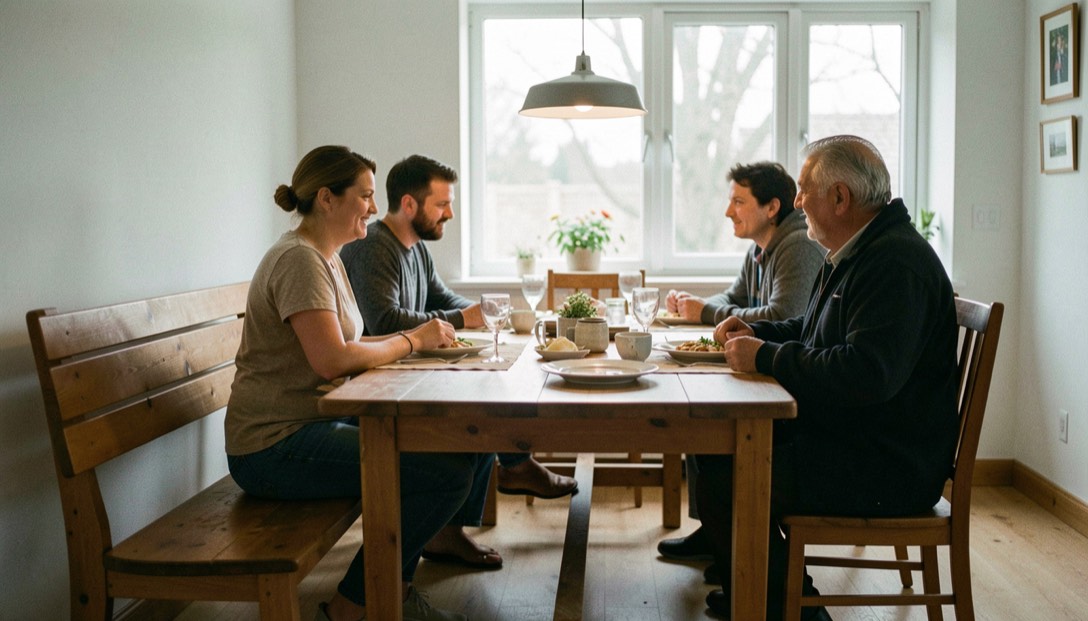
Benches beat chairs, by a lot. A bench takes no floor space behind it, it slides fully under the table, and three people can squeeze onto a bench built for two in a way that three cannot squeeze onto two chairs. Stools do the same job with less commitment. Mismatched seating is not a compromise here; it is the correct answer.
If part of your seating is at a counter, the heights have to work or people will not stay on them for more than ten minutes: the numbers are in stool height, counter height, and the gap between them.
The second surface
You almost certainly need one more horizontal surface than you own, and it does not have to be furniture. A plank on two trestles with a cloth over it. An ironing board at its highest setting, which is very close to bar height. A chest of drawers pulled out from a wall. A folding table with a board on top, which is a piece of kit a lot of homes already own for other reasons, described in setting up a pong table that does not wobble.
Put it where the standing zone is thinnest, cover it, and it becomes either the bar or the food, but not both.
Food that needs one hand
The constraint is simple: a standing guest has one hand, because the other is holding a glass. Everything you serve in the standing zone should be manageable with one hand and no plate.
- Things on skewers, which are the only food a standing person can eat cleanly.
- Bowls with tongs rather than platters, so people are not touching everything.
- One hot item that holds for three hours without deteriorating: a tray bake, a pot of something on the lowest heat, a loaf that comes out warm and gets cut on demand. The loaf in beer bread, two bowls, one hour exists for this slot, because it takes an hour, needs two bowls and no skill, and it is better warm than perfect.
- Nothing that requires cutting while standing up. A person sawing at something on a paper plate held in one hand is a person about to spill it.
Glasses and ice
Allow two glasses per person and accept churn. People put a glass down, lose it, and take a new one; the alternative is spending your evening as a lost property office. Chalk pen on the base, or charm bands, help a little; a tray for orphans helps more.
Ice is the thing most often underestimated. Roughly a kilogram per person for an evening where drinks are served over ice, half that if most people are drinking beer out of a tub. That is far more than a domestic freezer makes, so buy bagged ice and keep your own for the drinks that deserve it, as argued in ice at home: big cubes, clear cubes, and when it matters.
Put the ice where people can reach it without crossing the room, and put a tub of beer somewhere that is not the fridge, so twelve people are not queueing at a fridge door all evening.
The shape of the evening
- First hour: unstructured. People arrive over forty minutes and nothing should be scheduled. Drinks accessible, something to pick at, no host performance.
- Ninety minutes: food. Late enough that everybody has arrived, early enough that it lands well.
- Two hours: a reason to mix. This is the point where a room fragments into pairs and stops being a party. A game is the standard fix, and it wants to be one that everybody can join and that takes under two minutes to explain: High or Low for a room still on its feet, Kings Cup for a table that has settled.
- Three hours onward: let it run. Nothing scheduled, kettle on at some point, and the landing zone earns its keep.
The twenty minute cleanup
Put a bin liner somewhere visible at the start, run the sink with hot water once at the halfway point, and wash the glasses first while the water is clean. That last one is not just tidiness: it is the difference between glasses that are ready next time and glasses with a film on them, which is the whole argument in washing and storing glassware so the head survives.
Filed under Hosting. Published July 24, 2026.