High or Low: the simplest deck game at the table
One card face up, one guess, and a deck that never needs laying out. High or Low is the game to open an evening with, because it takes eleven seconds to explain and absorbs anybody who walks in halfway through.
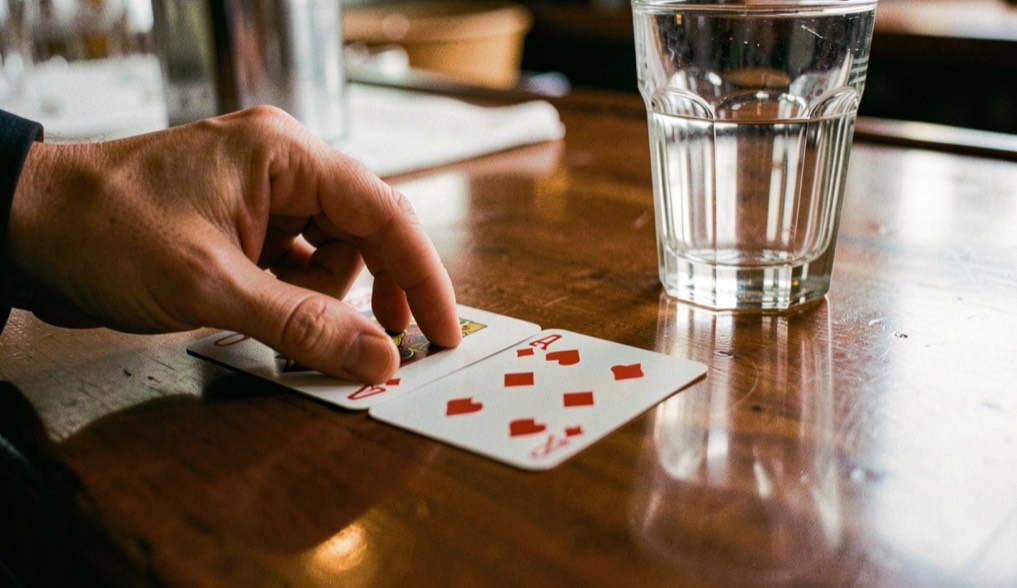
Every evening needs a game that can be started without anybody sitting down, explained while people are still taking their coats off, and abandoned the moment something better happens. High or Low is that game, and its simplicity is the feature rather than a limitation.
The base game
- Shuffle a standard deck and turn the top card face up in the middle of the table.
- The player to the dealer's left calls higher or lower for the next card, out loud, before it is turned.
- Turn the next card. Right, and the call passes to the next player. Wrong, and the caller drinks, then the call passes on.
- The card just turned becomes the new face up card, so every call is made against whatever the last player left behind.
- Play until the deck runs out, then reshuffle and carry on, or stop, which is equally valid.
The three things to decide first
Ties. If the new card matches the value of the old one, what happens? The cleanest rule is that a tie is a loss for the caller. The alternative, where a tie is a free pass, makes the game slightly gentler and slightly slower. Whichever you pick, say it before the first card, because a tie will come up within the first ten cards and somebody will have an opinion.
Ace high or ace low. Decide, and stick to it for the whole deck. Ace high is more common and makes the ace an easy call.
Suits. Irrelevant in the base game. If you want them to matter, that is the ladder version below.
Why it is not as random as it looks
The odds move enormously depending on what is showing, and good players think about it for the second and a half they have.
- Against a 2 or a 3, higher is nearly a certainty. Against a king or a queen, lower is.
- Against a 7 or an 8, the two options are close to even, which is where the game is genuinely a coin flip.
- Counting helps. A deck where all four aces have already gone is a deck where a king is a much safer call than it looks.
That is why the good house rule is that the caller must call before the card is even touched, and out loud. A mumbled call after the card starts turning is not a call.
Double or pass
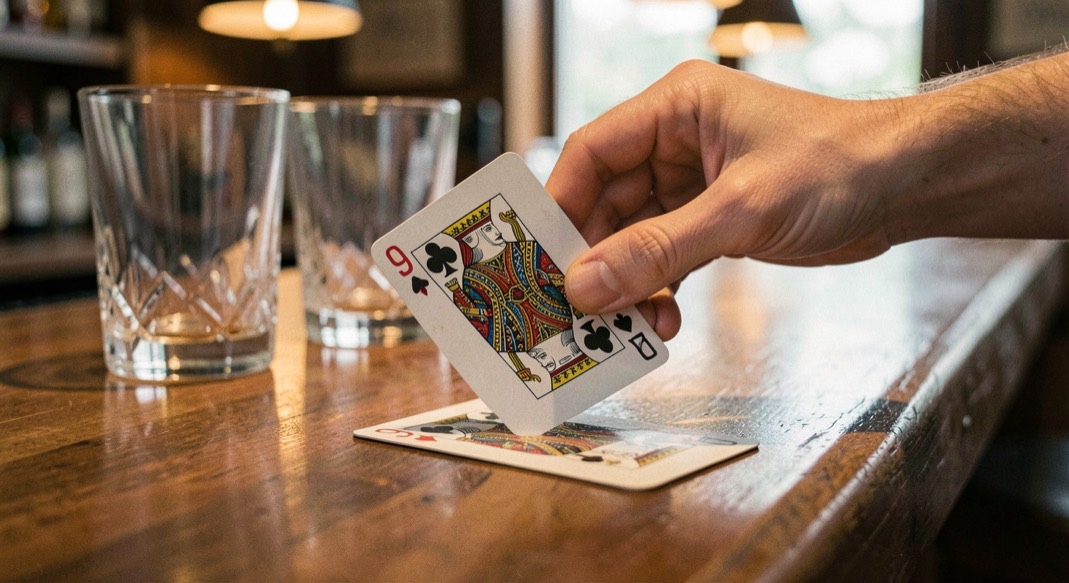
The one addition worth making to the base game. A player who has called correctly twice in a row may either pass the deck to the next player, or call a third time for double stakes. Called right, they nominate somebody else to drink twice; called wrong, they drink twice themselves.
It adds the only decision the base game lacks, it takes no explaining, and it stops the confident players simply riding a run.
The four card ladder
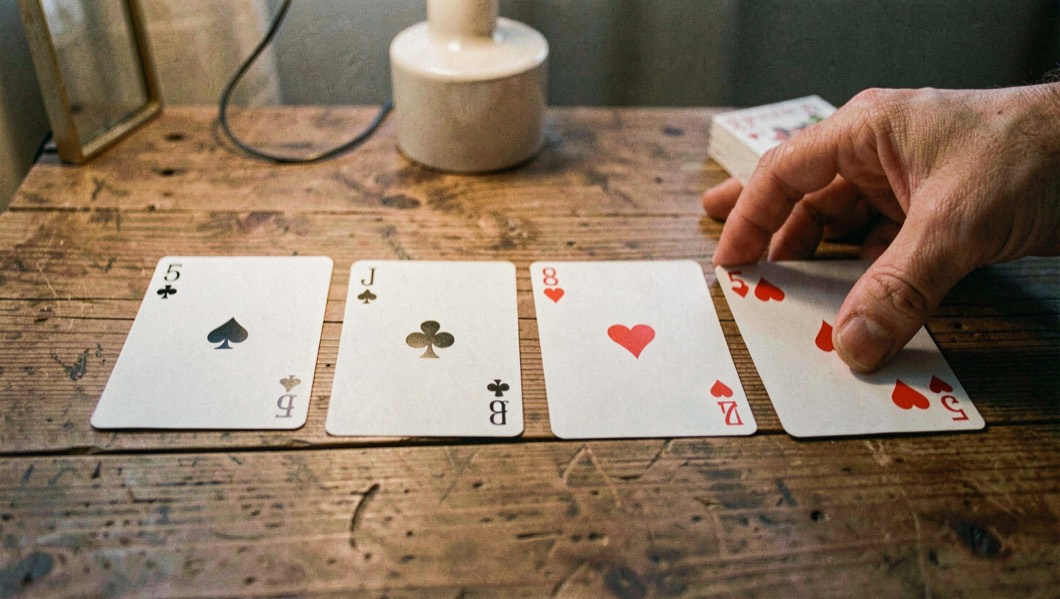
The longer version, which most people meet under a name involving a bus. Each player faces four questions in sequence, and getting any of them wrong sends them back to the start of their own ladder.
- Red or black? Turn a card. Wrong, drink one and the turn passes.
- Higher or lower than the first card. Wrong, drink two.
- Inside or outside the range of the first two cards. Wrong, drink three.
- Name the suit. Wrong, drink four.
A player who gets all four correct passes the whole ladder to the player of their choice. The escalating penalty is what gives the ladder its shape, and the third question, inside or outside, is the one people get wrong most often because they forget how wide the gap between their first two cards actually is.
Why it belongs at the start of the evening
- It needs no setup, no clear table and no seating plan. It can be played standing at a kitchen counter.
- It works with three players and it works with fifteen, because everybody is only ever waiting for one card.
- It is the only card game on this shelf that a latecomer can join in the middle of a hand, which matters at a party where people arrive over an hour.
- It stops cleanly. Nobody is halfway through a structure that has to be finished.
What to move on to
Once the room has settled and everybody can reach the middle of the table, this is the point to switch to something with a proper arc. Kings Cup is the standard next step, and it takes about ninety seconds to explain to a table that is already holding cards. Asshole is the other direction, a real card game with a social structure bolted on, and it rewards a table that is going to stay put for an hour.
If the group turns out to want games rather than drinking games, the switch is easy from here, and the shortlist of what actually works beside full glasses is in board games that survive a crowded table.
Filed under Drinking games. Published November 12, 2025.