Ice at home: big cubes, clear cubes, and when it matters
Ice is the only ingredient in a drink that keeps changing it after you have handed it over. Size controls how fast that happens, clarity controls almost nothing, and knowing which is which saves a lot of freezer space.
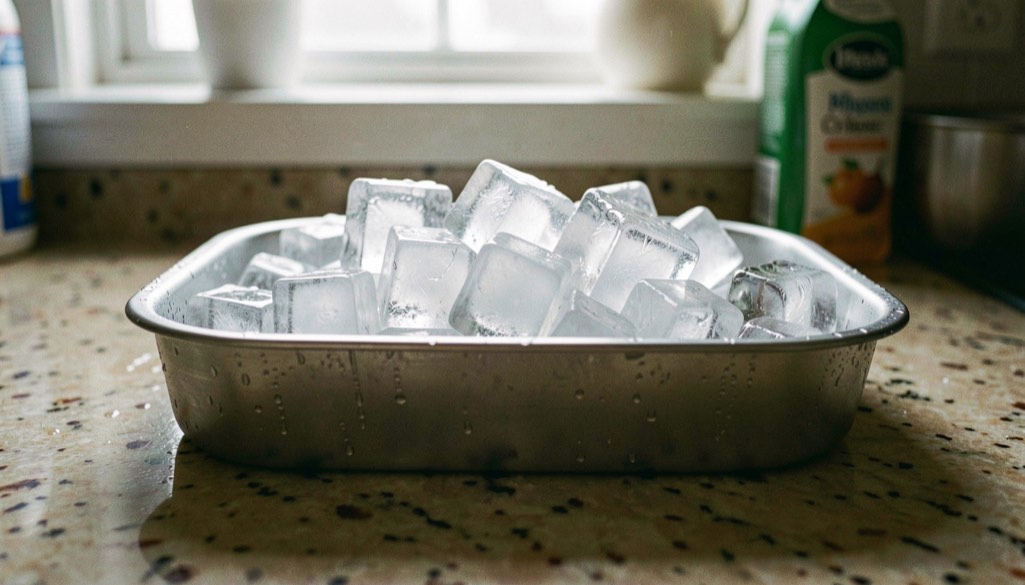
Two questions get muddled together whenever ice comes up at a home bar. One is about size, which changes how a drink behaves in the hand. The other is about clarity, which changes how it looks and almost nothing else. They have different answers and different amounts of effort attached.
Size is a dilution rate
Ice melts from the outside, so what matters is the ratio of surface to volume. Double the edge of a cube and you get eight times the volume but only four times the surface, which means the big cube carries far more cooling capacity per square centimetre of melting face.
In practice: a tray of small 2.5 cm cubes chills a spirit fast and waters it down over about fifteen minutes. A single 5 cm cube chills more slowly and is still recognisably a drink after forty. Neither is better. They are two different drinks.
- Stirred and served over a single rock, drunk slowly: big cube.
- Shaken hard then strained into a cold glass with no ice at all: small cubes in the tin, because you want fast chilling and a controlled amount of dilution.
- A tall drink with a mixer: fill the glass to the top with ordinary cubes. A full glass melts more slowly than a half full one, which is the opposite of what most people expect.
- Crushed: any ice at all, smashed. See below.
Why domestic ice is cloudy
A tray in a freezer chills from every side at once. Water freezes outward from all six faces, and the dissolved air and minerals that cannot fit into the ice crystal get pushed ahead of the freezing front, into the middle, where they end up trapped as a white core of microscopic bubbles.
Boiling the water first helps a little, because it drives off some dissolved gas, and boiling twice helps slightly more. Neither gets you a clear cube, because the problem is the direction of freezing rather than the water.
Directional freezing, in a normal freezer
- Take a small insulated cool box, the soft or hard kind, that fits in your freezer with the lid off. A 4 to 6 litre one is plenty.
- Fill it two thirds with cold tap water and put it in the freezer, lid off and open side up.
- Leave it for 18 to 24 hours. The insulated sides and base slow the freezing so that the only fast route for heat is upward, and the ice grows downward as a clear sheet.
- Stop before it freezes solid. You want a clear slab sitting on a still liquid layer of the concentrated, cloudy water.
- Tip the water away, turn the slab out, and leave it on a board for five to ten minutes to temper.
That tempering step is the one people skip and then regret. Ice straight from a domestic freezer is at around minus 18 degrees and is under internal stress; a knife into it at that temperature makes it crack unpredictably and sometimes explosively. Warmed to the point where its surface goes wet, it cuts cleanly.
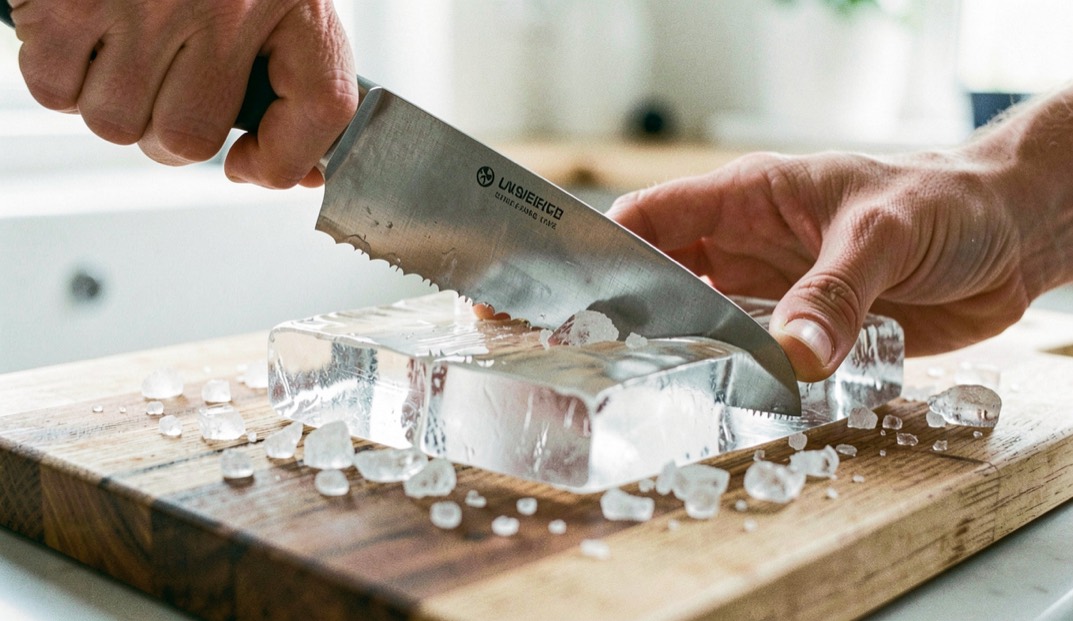
Cutting the slab
Score a line across the slab with a serrated bread knife, working the teeth back and forth until you have a groove a couple of millimetres deep, then tap along the groove with the back of the blade or with the handle. It splits along the line. Repeat at right angles for cubes.
Keep the offcuts. Irregular shards are the best possible ice for shaking and for a jug, and there is no reason to make a second kind of ice for that job.
Storing what you cut
Loose ice in a freezer drawer sublimates, shrinks, and takes on the smell of everything around it. Bag the cubes, press the air out, and keep the bag away from anything strong. Ice absorbs odour readily, which is the same reason a glass stored rim down in a freezer comes out smelling of last week, a habit argued against in washing and storing glassware.
Crushed ice without a machine
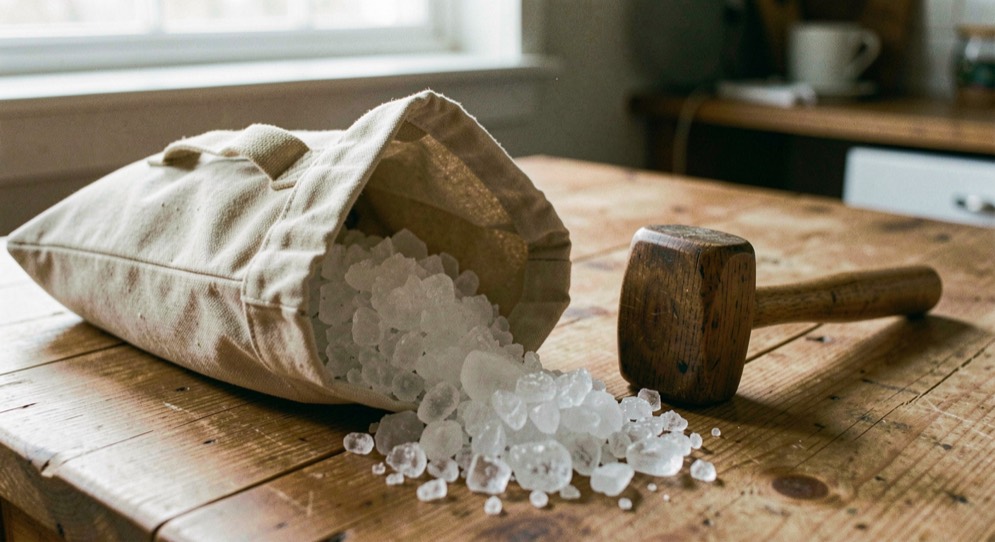
A canvas Lewis bag and a wooden mallet is the whole apparatus. The canvas wicks the meltwater away, so what comes out is dry crushed ice that packs into a glass instead of slumping into slush. Fill the bag a third full, fold the end under, and hit it in the middle rather than at the ends.
A clean tea towel and a rolling pin does the same job slightly worse. A blender does it very badly and shortens the life of the blender.
When none of this matters
Clear ice does nothing to a drink that is opaque, nothing to a drink you finish in five minutes, and nothing whatsoever to beer. Cloudy ice is not dirty and does not taste different; the bubbles are air.
Where it earns its effort is a short, spirit forward drink in a clear glass, served over one rock, that somebody is going to hold for half an hour. There, the cube is a visible part of the drink and it is also doing real work on the dilution.
How much to make for a night
Plan on about a kilogram per person for an evening where drinks are served over ice, and half that if most people are drinking beer from a tub. That is far more than a domestic freezer produces in a day, so buy bagged ice for the crowd and keep your own cubes for the drinks that deserve them.
The tub itself wants to be somewhere people can reach without crossing the room, which is a circulation question rather than an ice question, and it is one of the zones mapped out in a twelve person night on a six person table. Keep the jigger and the strainer beside the ice rather than by the sink, for the same reason the drawer in the six tools that earn their drawer space sits under the pour and not across the kitchen.
Filed under Bar essentials. Published January 13, 2026.