Anchorman: the rules, and the argument about the cap
The scoring in Anchorman takes thirty seconds to explain. The disputes take an hour, and they are always about the cap. Settle those three rulings first and the game runs itself.
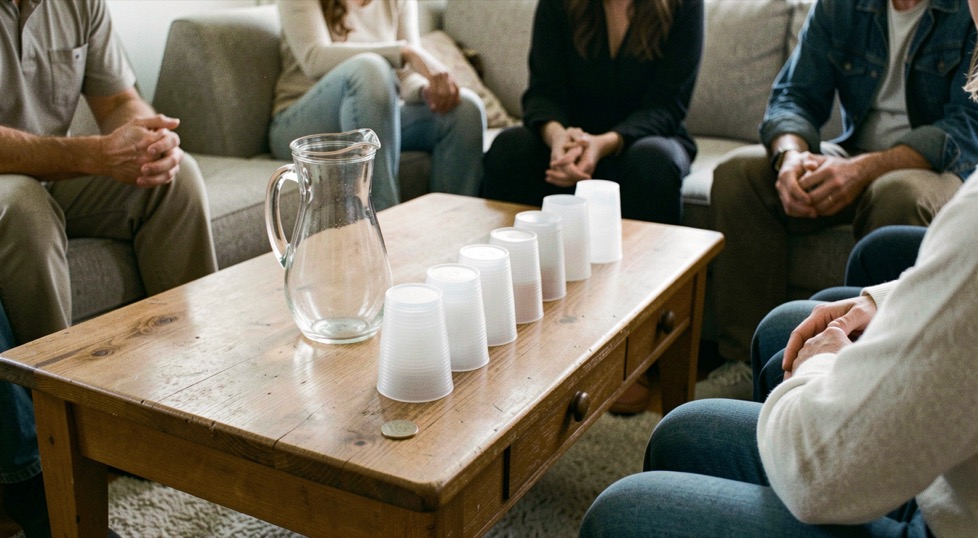
Anchorman is a team game with a very short rule set and a very long list of edge cases. It is played across a table between two sides, and it turns on a bottle cap that has to be flicked into a cup. Everything that makes it fun and everything that makes it stall comes from that cap.
What you need
- Two teams of equal size, three or four a side, facing each other across a table.
- One pitcher in the middle. Keep it to a litre; the reason is at the end of this page.
- One cup per player, with a measured amount in each.
- A bottle cap, ideally a crown cap with the crimped edge intact rather than a flat disc, because the crimp is what makes it sit rather than skid.
- A table with a hard, flat surface. Anything with a cloth on it kills the game.
The base game
- Teams alternate. One player from each side takes a turn in order, so everybody flicks the same number of times.
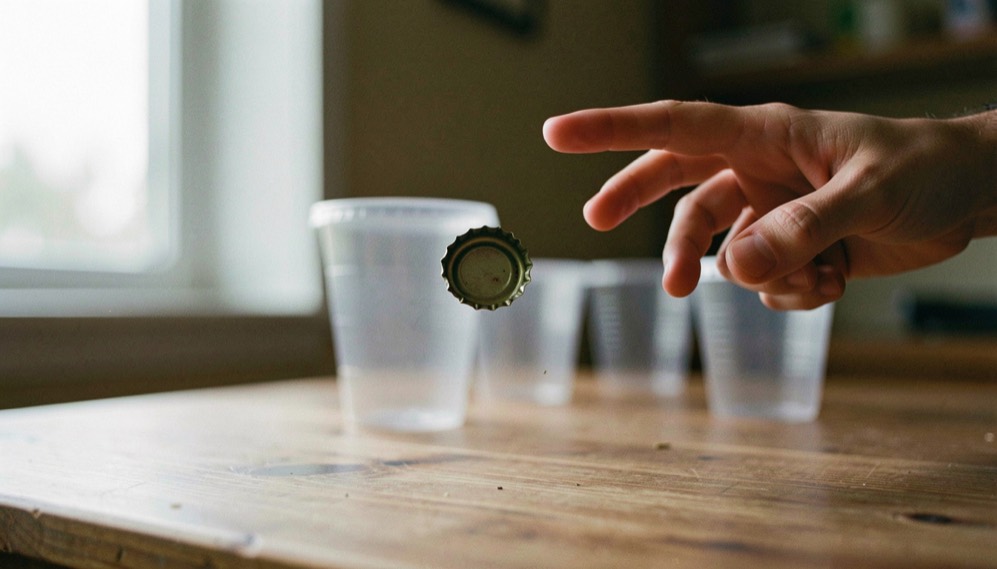
- On your turn, flick the cap so that it lands in your own cup. You may flick it directly through the air or bounce it once off the table, depending on which rulings you have adopted.
- A cap that lands and stays in your cup scores a point for your team. Take the cap out, and the turn passes to the opposing team.
- A miss scores nothing and the turn passes.
- Each point scored means the opposing team pours a measure from their own cups into the pitcher, or drinks a measure, depending on the version. Pouring into the pitcher is the version that leads to the anchorman finish.
- First team to an agreed score, commonly five, wins the round.
The three rulings
Every group that plays this game argues about the same three things, always in the middle of a turn, always with a cap already in the air. Rule on them before the first flick and the game never stops.
1. Does a cap that lands on the rim and spins in count? Recommended answer: yes, if it comes to rest inside the cup, it counts, whatever route it took. The alternative, where the cap has to enter cleanly, requires a judge and produces a dispute every time.
2. Does a bounce off the table count? Recommended answer: one bounce is legal, two is not. A single bounce is the shot most players are actually attempting and banning it removes most of the skill from the game. Two bounces turns it into a different game entirely.
3. Does the cap have to land a particular way up? Recommended answer: no. Orientation rules exist and they add nothing except an extra thing to squint at. If you want a harder game, move the cups further away rather than adding an orientation rule.
The anchorman
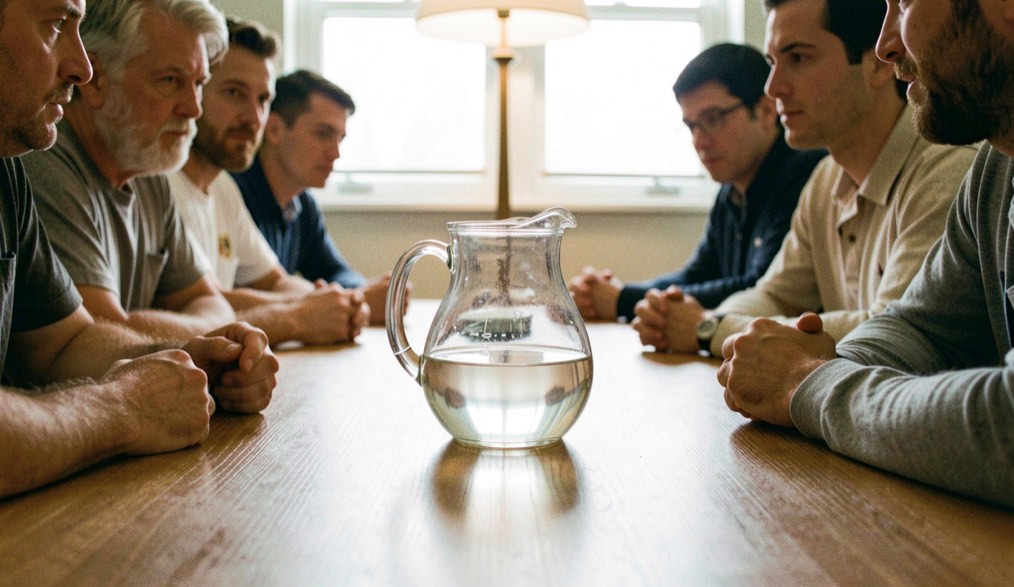
The name comes from the finish. When a round ends, the losing team has one player designated as the anchorman, usually chosen before the round starts rather than after, and the anchorman has to finish the pitcher.
If the anchorman finishes it, their team survives to play the next round. If they cannot, the round is confirmed lost. That is the classic structure, and it is also where the game gets away from people, because a pitcher that has been filled all round can hold a great deal.
How to keep the finish sensible
Three adjustments, all common at home tables. Cap the pitcher at one litre and stop pouring once it is full. Allow the anchorman to nominate one team mate to share it. And let the anchorman top the pitcher with water without comment, which is the same convention used for the central glass in Kings Cup. None of these change the shape of the game and all of them make it a game you can play twice.
Choosing the anchorman
Pick before the round, not after. An anchorman chosen after the loss is a person the team has just voted against, and that is a different and worse evening. The usual method is to rotate: each player anchors one round in turn, so over a session everybody takes a finish.
The anchorman also flicks last in the order, which gives the role a second function. The last flick of a round is the one under pressure, so the anchorman is both the player who might win it and the player who pays if they do not.
The surface, and where to play it
Anchorman wants a hard, flat, wipeable table with a clear centre. A coffee table works if everybody can reach; a dining table works better because people are sitting at a sensible height and the cups are at flick level. A cloth of any kind is fatal, because a cap that lands on fabric stops dead rather than bouncing.
The same requirement makes a levelled pong table an excellent surface for this game, and if the table is not level the cap will drift consistently in one direction, which is genuinely infuriating. The levelling method is in setting up a pong table that does not wobble, and it applies to any game that involves something rolling or bouncing on a table. The other game on this shelf with the same hard surface requirement is Quarters, and if your table gives a good bounce for one it will give a good bounce for the other.
The pitcher itself
A glass pitcher on a table full of flicked metal objects is a calculated risk. Use one with a thick base and a wide mouth, and stand it in the middle rather than at the edge where a sleeve can catch it. Wash it properly afterwards, because a pitcher that has held a mixed pour and then dried is a serious job, and the routine for that is the same one described in washing and storing glassware so the head survives.
If the table is not up for it
Anchorman needs a table of six to eight people who are all in, all at the same time. If half the room is talking, the game will not start. The game to reach for instead is one that can be joined mid hand and abandoned mid hand, which is High or Low. And if the room wants something loud and physical instead of something precise, the answer is a race: Flip Cup: how to run a fair race.
Filed under Drinking games. Published March 18, 2026.