Quarters: the bounce, the chain, the table
A coin, a hard table and a glass. Quarters has almost no rules and an enormous amount of technique, and most of what looks like luck is actually the surface you are playing on.
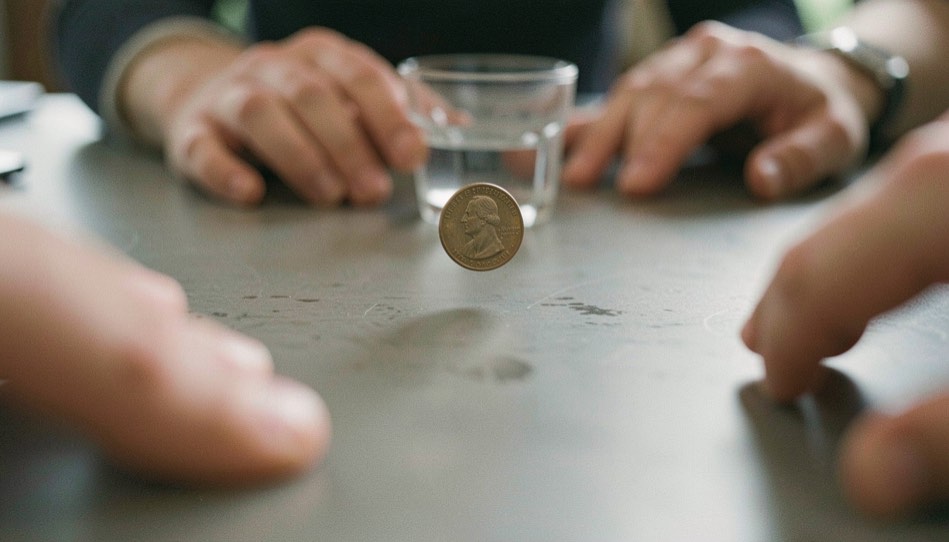
Quarters is the smallest game on this shelf. One coin, one glass, one hard table, and no equipment that has to be bought or set up. It is also the game where technique makes the biggest difference, which is why the same two people tend to win it all evening.
The base game
- Put a glass in the middle of the table, about half full.
- On your turn, bounce the coin once off the table so that it lands in the glass.
- Make it, and you nominate a player to drink, then shoot again.
- Miss, and the coin passes to the player on your left.
- Make three in a row and you may invent a rule that holds for the rest of the game. This is the chain.
That is the whole game. Everything else is house convention, and the conventions are worth agreeing because they change the game considerably.
The table decides the game
A coin bounces predictably off a hard, dense, flat surface and unpredictably off anything else. Laminate, lacquered hardwood, glass and stone all work. A soft pine table, a table with a cloth, a table with a cracked veneer or a table that flexes in the middle will not give you a repeatable bounce, and a game without a repeatable bounce is just a game of chance with extra arm movement.
The fix, if the only table is a soft one, is a hard board laid on top: a chopping board, a tray with a flat base, or the sheet of MDF that a pong table wants anyway, described in setting up a pong table that does not wobble. A hard board in the middle of a soft table gives everybody the same bounce and takes ten seconds to produce.
The coin, and the two legal holds
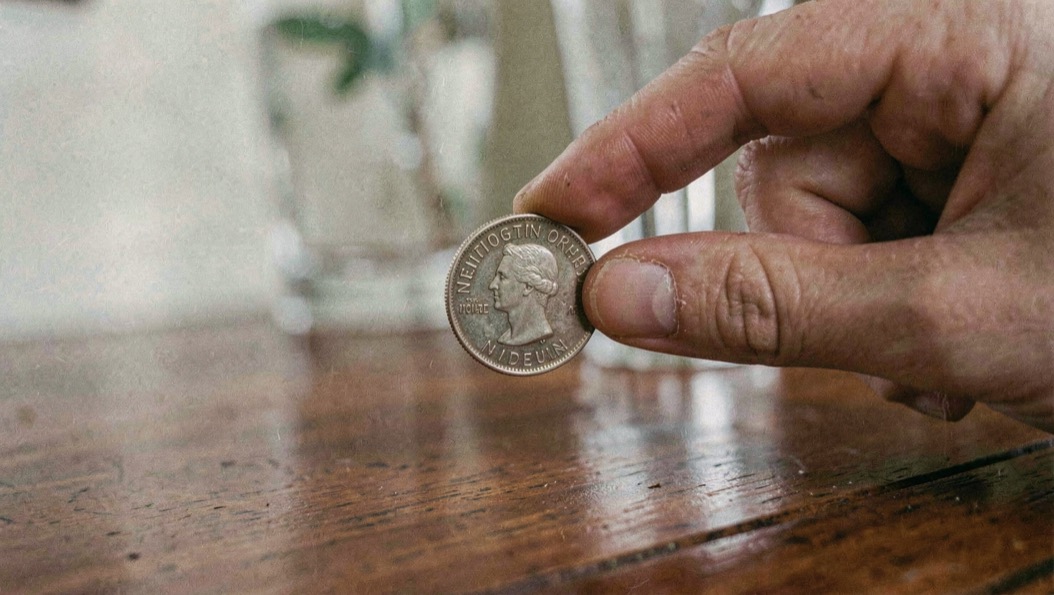
Use a coin with a milled or reeded edge. A UK pound coin, a US quarter, a two euro piece: all bounce truer than a smooth edged coin because the milling grips the surface for a fraction longer and converts spin into a cleaner rebound. A thin, light, smooth coin skids.
There are two holds worth knowing, and most tables allow both.
- The flat drop. Hold the coin flat between thumb and forefinger, a few centimetres above the table, and push it straight down. It bounces almost vertically. Reliable, low, and the hold most people learn first.
- The edge spin. Hold the coin vertically on its edge and flick the top so it spins as it hits. The spin gives it a flatter, longer bounce, which lets you shoot from further out and gives you more control over the height of the arc.
Aim at a spot on the table five to ten centimetres in front of the glass, not at the glass itself. The bounce is the shot; the glass is just where the coin ends up.
The glass
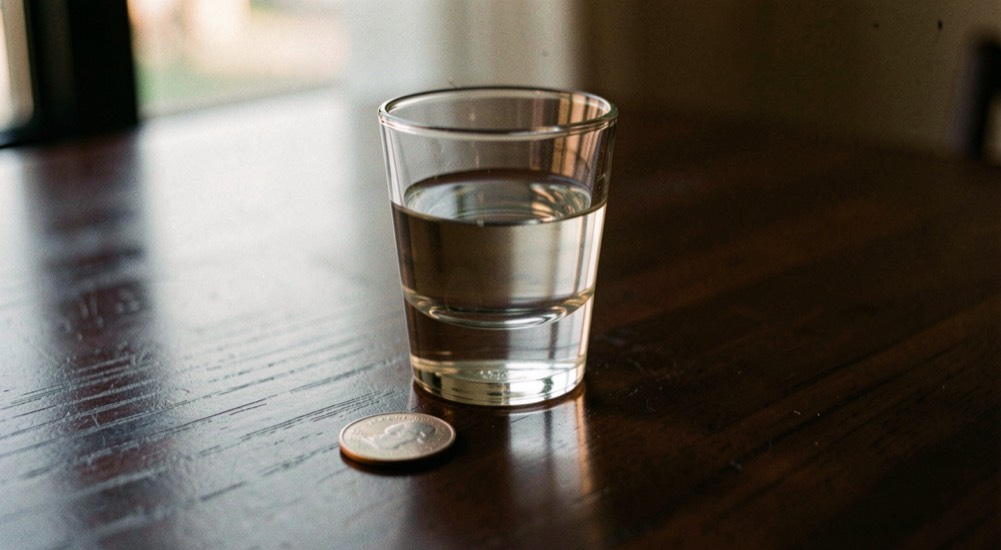
Wide mouthed, heavy, and about five centimetres tall. A shot glass with a thick base is the classic and it works because it does not move when a coin hits the rim. A tall thin glass tips, and a glass with a narrow mouth turns the game into a lottery.
Keep it about half full. An empty glass lets the coin bounce straight out again, which is maddening and which some tables count as a miss and others as a make. Half full and the liquid absorbs the coin. Full and the coin displaces the drink onto the table.
The chain, and what a rule may do
Three consecutive makes earns you a rule. Rules made in Quarters are the same species as the rules made on a jack in Kings Cup: they hold for the rest of the game, they stack, and the funny ones are the ones that make people fail at something they do constantly. No first names. No saying the word drink. Coin held in the weak hand.
Two limits are worth agreeing at the start. A rule may not target one named player, and a rule may not make the game unplayable, which means nothing that forbids bouncing or holding the coin. Beyond that, let them stack; the pile up is the fun.
House variations worth knowing
- Pass the glass. On a make, the shooter passes the glass to the next player rather than shooting again. It spreads the game around a table where one player is much better than the rest.
- Chancellor. A player who makes three in a row becomes chancellor and may make one rule at any point later, saving it. More strategic, slightly slower.
- Two glasses. A small glass and a large one, worth different amounts. Adds a decision to every shot and works well at a table of four or fewer.
The coin, and the sensible bit
A coin that has been in a pocket goes into a drink. Keep one clean coin for the purpose, washed and dried, and do not use whatever came out of somebody's change. It costs nothing and it removes the one genuine objection to the game.
How the game ends
It does not, which is its one real weakness. Quarters has no built in finish, so it runs until the table gets bored and stops mid turn. Give it an ending before you start: ten minutes on a timer, first to five rules, or a lap of the table with no makes.
That is the opposite of the card games on this shelf, which all carry their own clock. Kings Cup ends on the fourth king and Circle of Death can end on any careless reach. Quarters ends when you say it does, so say it early.
One more practical note. The glass in the middle takes a coin at speed dozens of times an evening, and glass that has been chipped on the rim is glass you should not be drinking from. Check the rim under a light before you put it back on the shelf, which is the same inspection habit argued for in washing and storing glassware so the head survives.
Filed under Drinking games. Published February 5, 2026.