Flip Cup: how to run a fair race
Flip Cup is a relay, and relays are only fun when they are fair. Five decisions, all made before the first race, are what separate a proper contest from an argument about who started early.

Flip Cup is the simplest team game on this shelf and the one most often played badly. The rules take twenty seconds. The fairness takes five decisions, and if you skip them the race is decided by who is standing closest to the edge of the table.
The base game
- Two teams of equal size stand facing each other along the two long sides of a table.
- Each player has a plastic cup in front of them with the same measured amount in it, sitting on the table with the base near the edge.
- On the signal, the first player on each team drinks their cup empty.
- They place the empty cup upright on the table with roughly a third of its base overhanging the edge.
- They flip it with one finger from underneath the overhanging base, so it turns over in the air and lands upside down on the table.
- Only when the cup lands rim down may the next player on that team start.
- The first team whose last player lands a cup wins.
The five decisions
1. Measure the pour. Use a jigger and give every cup the same amount, somewhere between 50 and 80 ml. Poured by eye, cups vary by a factor of two, and a race where one player has twice as much to drink is not a race. A jigger is on the short list of tools in the six tools that actually earn their drawer space for exactly this kind of reason.
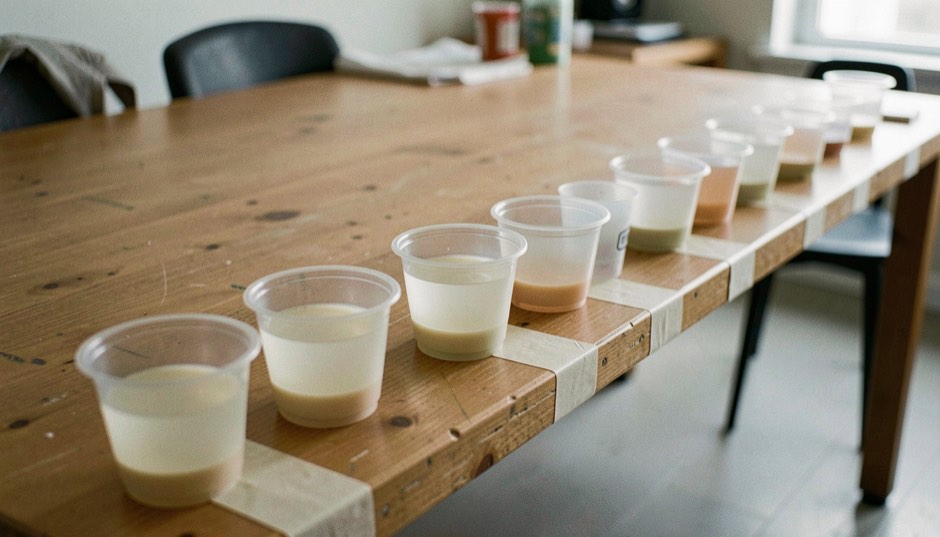
2. Mark the lanes. Two strips of tape down the table, one per team, with a cross at each player position. Cups start on the crosses. Without lanes, players creep their cups toward the middle of the table where the flip is easier, and everybody creeps at a different rate.
3. One signal, called by a non player. Somebody who is not racing calls it. A team mate calling the start is a team mate whose own side hears it a fraction earlier, which they will deny, and they will be right, and it will still be true.
4. The overhang rule. The cup must be flipped from the table, not from the hand, and the base must be resting on the table when the flick happens. Picking the cup up and tossing it is faster and it is not the game.
5. Failed flips are re flipped from where they land. No sliding the cup back to a better spot, no re placing it on the cross. A cup that lands on its side halfway along the table is flipped from there, which is a real penalty and is the entire skill of recovering from a bad first attempt.
The flat cup problem
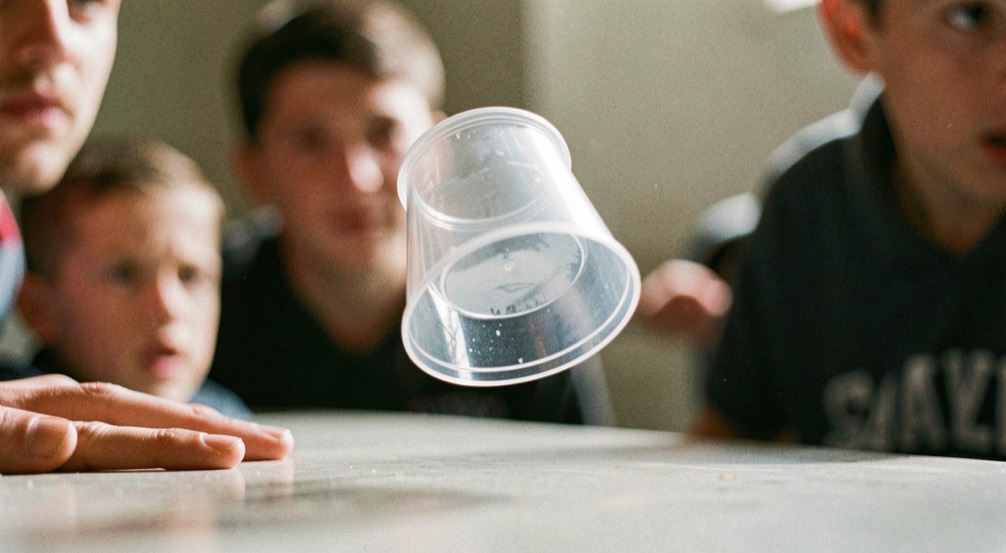
A cup that has been flipped fifty times develops a deformed, slightly out of round rim, and a deformed rim does not land flat. It rocks, settles on one side, and the player has to flip again while their team shouts. It looks like bad luck and it is actually a worn out cup.
Retire cups after a session, or check them by standing each one rim down on a flat surface and pressing one side; a cup that rocks goes in the bin. Ribbed party cups of 473 ml (16 oz) flip more consistently than smooth thin ones, because the ribs give the cup a defined pivot as it leaves the table and a stiffer wall that keeps its shape longer.
Team order
The order is the only tactical decision in the game, and most teams get it wrong by putting their best flipper last.
- First position sets the tone and should be somebody reliable rather than spectacular. A first player who takes four attempts has already lost the race.
- Second position is where to hide your weakest flipper, because there is still time for the rest of the team to make it up.
- Last position is the one under pressure, and it should be your most consistent player rather than your fastest. Consistency wins relays; speed loses them in a single bad flip.
The table
You want a long, level, hard, wipeable surface with room for four or five people a side. An eight foot table takes four a side comfortably. The table must be level, because on a sloping table the cups on the low side land flat more easily and the race is decided by the floor. The levelling routine is the same one in setting up a pong table that does not wobble, and it takes two minutes.
Table height matters too. A dining height table puts the cup at a comfortable flicking height for most people. A raised bar counter puts it too high, and everybody flips upward, which reduces the whole thing to luck.
Uneven teams
If the sides do not divide evenly, the shorter team nominates one player to go twice, and that player goes first and last. Do not leave a player out; a person standing behind a Flip Cup race is a person who has left the party.
When to play it
Flip Cup is a loud, standing, whole room game that lasts ninety seconds a race, which makes it the right thing at about the two hour mark when a party has fragmented and needs mixing. That timing is the same one recommended for any structured activity in a twelve person night on a six person table.
It also runs perfectly well on water or a soft drink, which is worth saying out loud before you divide the teams, because a relay is one of the few games where nobody can tell what is in the cup and nobody needs to. If the room wants precision rather than noise, the game to switch to is Anchorman, which uses the same table and half the same equipment.
Filed under Drinking games. Published December 22, 2025.