Back bar lighting without the glare
A back bar is lit well when you notice the bottles and not the fittings. That takes three decisions: where the light sits, what colour it is, and how far down it goes when the evening turns.
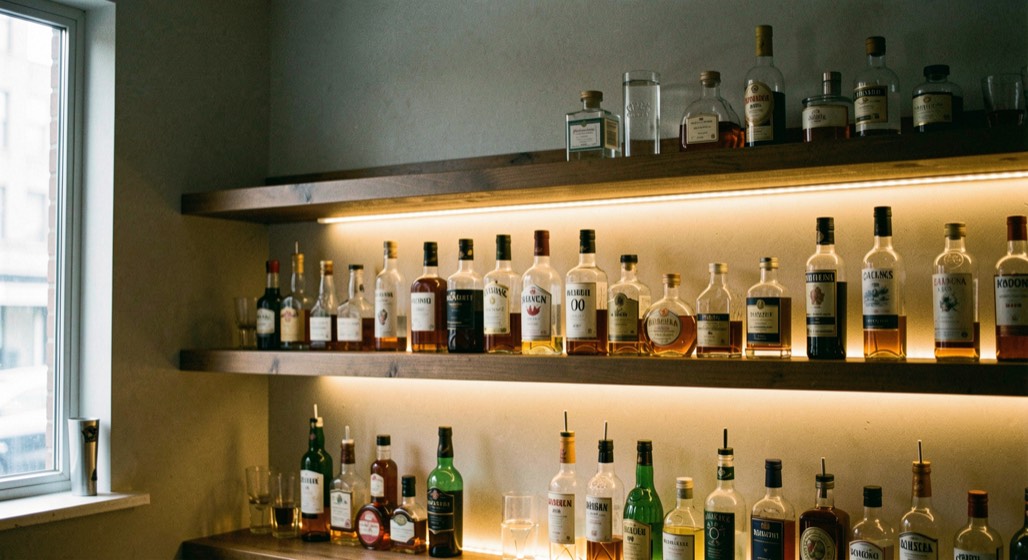
Most home bars are lit by whatever was already in the ceiling. That light comes from above and slightly behind the person standing at the counter, which does three unhelpful things at once: it puts their own shadow on the work surface, it bounces off the top of every bottle instead of through it, and it lands on the faces of the people sitting opposite.
The fix is not more light. It is light placed low, aimed at glass, and turned down.
Light the bottles from underneath
A bottle is a lens full of coloured liquid. Light entering it from below travels the length of the liquid and comes out the shoulder, which is why a bar with under shelf lighting looks like a bar and a bar with a ceiling spot looks like a pantry.
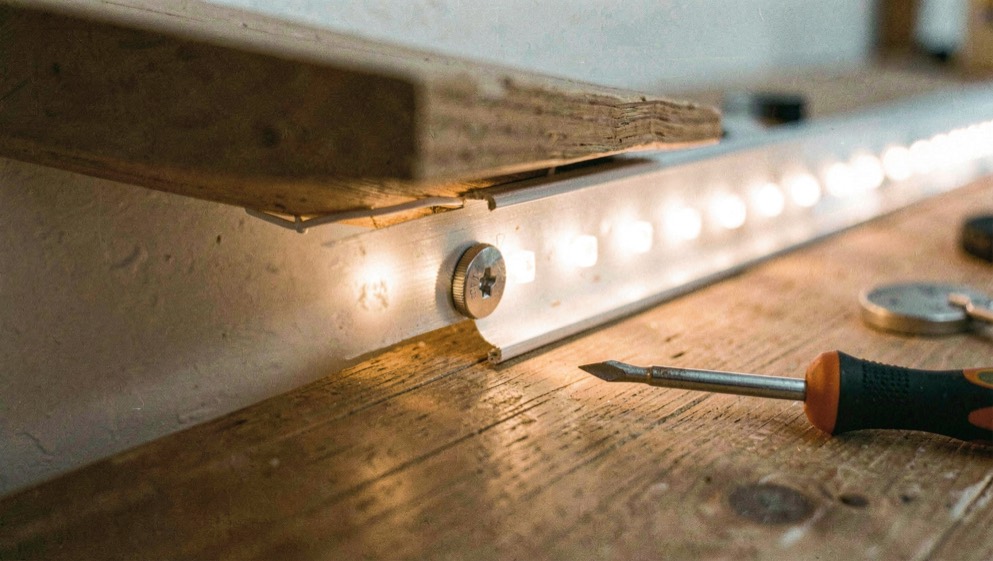
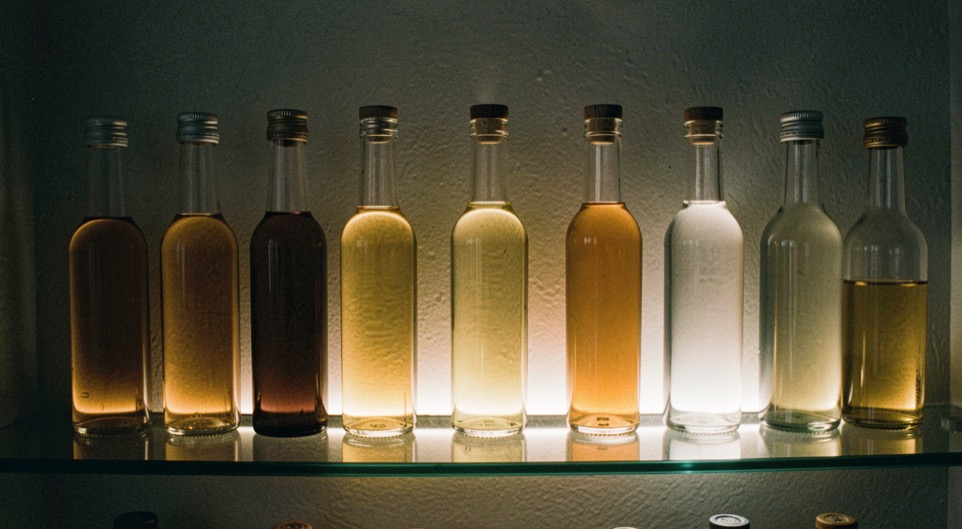
Two positions do the job. The first is a strip fixed to the underside of each shelf, set back 20 to 30 mm from the front edge so the lip of the shelf hides the diode line from anyone sitting at normal height. The second, if your shelves are glass, is a strip along the back of the shelf below, firing forward and up through the base of the bottles standing on the glass above.
Both want an aluminium channel with a frosted diffuser. The channel is not trim, it is a heatsink, and a strip run bare against wood will dim and shift colour within a couple of years. The diffuser turns a row of dots into a line, which is the difference between a fitted bar and a taped one.
Colour temperature, and why 2700 K is the ceiling
Bar light should sit between 2200 and 2700 K. At 2200 K you are in candle and filament territory, flattering and slightly amber. At 2700 K you are at soft white, which reads as warm domestic light. At 3000 K a bar starts to look like a kitchen, and at 4000 K it looks like a chemist.
The number that matters almost as much is colour rendering. Look for CRI 90 or better. Cheap strips at CRI 80 flatten reds and browns, which is a strange thing to do to a shelf of whisky and amber ale. The difference costs very little and is visible immediately.
Mix nothing. One colour temperature across the whole bar, including any pendant above the counter. Two temperatures in one small room read as a fault rather than as layering.
Brightness and the dimmer
Under shelf lighting needs far less power than people fit. Around 8 to 10 watts per metre of strip is plenty behind bottles, and anything above 14 turns the shelf into a display case. Run 24 volt strip rather than 12 volt for any run over about three metres, because voltage drop makes the far end of a 12 volt run visibly dimmer than the near end.
Put the whole back bar on one dimmer and nothing else on that circuit. A bar is not one room, it is three evenings: bright while you set up and clear away, medium while people arrive, low once the table has settled. A dimmer is what lets one fitting cover all three.
The one fixture to remove
A single bright downlight directly above the front edge of the counter is the fitting that ruins everything. It sits high and slightly in front of whoever is pouring, so it drops their shadow onto the work surface, blows a white hotspot onto the shoulder of every bottle, and lands on the foreheads and eye sockets of everyone sitting at the bar.
It is also the reason every photograph taken at a home bar looks worse than the bar does. The camera exposes for the hotspot, and the rest of the room falls into darkness behind it.
If the downlight cannot come out, put it on its own switch and leave it off, or swap it for a narrow beam aimed at the wall behind the shelves rather than at the counter. Wash the wall, never the faces.
The working light, kept separate
You do still need to see what you are doing. A small warm puck or a short strip under the front overhang of the counter, aimed down at the cutting board and the jigger, gives you working light without lighting the room. It runs on its own switch and goes off when you stop making drinks.
This matters for accuracy as much as for atmosphere. Reading a jigger under a top light means reading a cone with a shadow in it, which is a small reliable way to overpour, and one of the reasons the measuring advice in the six tools that earn their drawer space insists on interior markings you can see.
Two details nobody fits and everybody notices
A toe kick strip at the base of the bar front, dim, does more for the look of a counter than anything on the shelves: it lifts the whole unit off the floor visually and it stops people kicking the plinth in the dark.
And a low light on the glassware shelf, if your glasses are stored on open shelving, shows you at a glance which glasses are actually clean. That is not vanity. Film and water spots are visible under raking light long before they are visible under a ceiling lamp, which is exactly the inspection described in washing and storing glassware so the head survives.
One last practical note. Whatever you fit, sit down on a stool before you screw anything permanently in place and look at the shelves from that height, because the seated eye line is where the glare will show up. If your stools are the wrong height to begin with, fix that first: the numbers are in stool height, counter height, and the gap between them.
Filed under Bar essentials. Published April 2, 2026.