Head retention: what the foam is telling you
The head on a beer is a readout. It reports on the pour, then on the glass, then on the beer, in that order, and each of the three leaves a different signature in the foam.
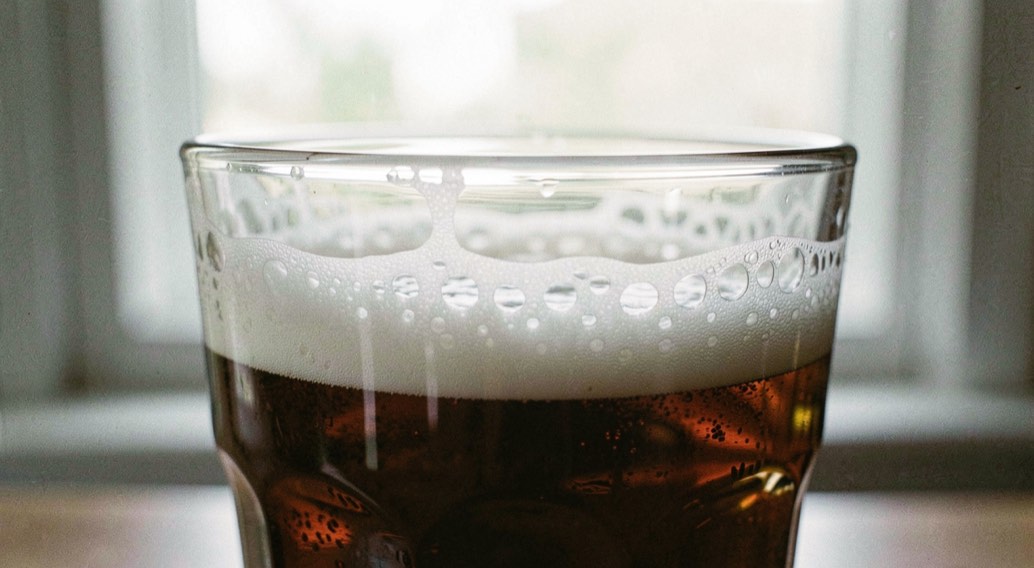
Foam is the most informative part of a beer and the part people look at least. It forms in seconds, it changes continuously, and its behaviour is determined by things you can actually control.
What foam is
A beer head is a mass of gas bubbles, mostly carbon dioxide, whose walls are thin films of beer held together by surface active molecules. Two families do most of that work.
The first is protein, specifically the medium sized polypeptides that survive the brewing process. They come from the grain, and malted wheat and malted barley bring different amounts. Wheat brings more, which is the reason a wheat beer foams the way it does and the reason the glass in why a weizen glass is shaped like that is built with 200 ml of headspace it will never fill with liquid.
The second is the iso alpha acids from hops, which are the compounds responsible for bitterness. They gather at the bubble walls and stiffen them. This is why a heavily hopped beer tends to hold a head longer and leave more residue on the glass than a lightly hopped one of the same strength.
What destroys it
Fat, in essentially any quantity. Lipids are more surface active than the proteins holding the bubble walls together, so they displace them, and the film ruptures. The sources are the same short list every time.
- A glass with a film of grease inside it, from washing up water that had a roasting tin in it, or from a rinse aid cycle.
- Fingers, lips and lip balm.
- Crisps, nuts and anything else eaten by hand next to an open glass.
- Citrus oil, which is why a wedge of lemon takes the collar off a wheat beer as you watch.
The scale of it surprises people. A single fingerprint of butter inside a pint glass will take a good head down to nothing within a minute. That is the entire argument behind the tests in washing and storing glassware so the head survives, and it is worth knowing before you blame the beer.
Lacing
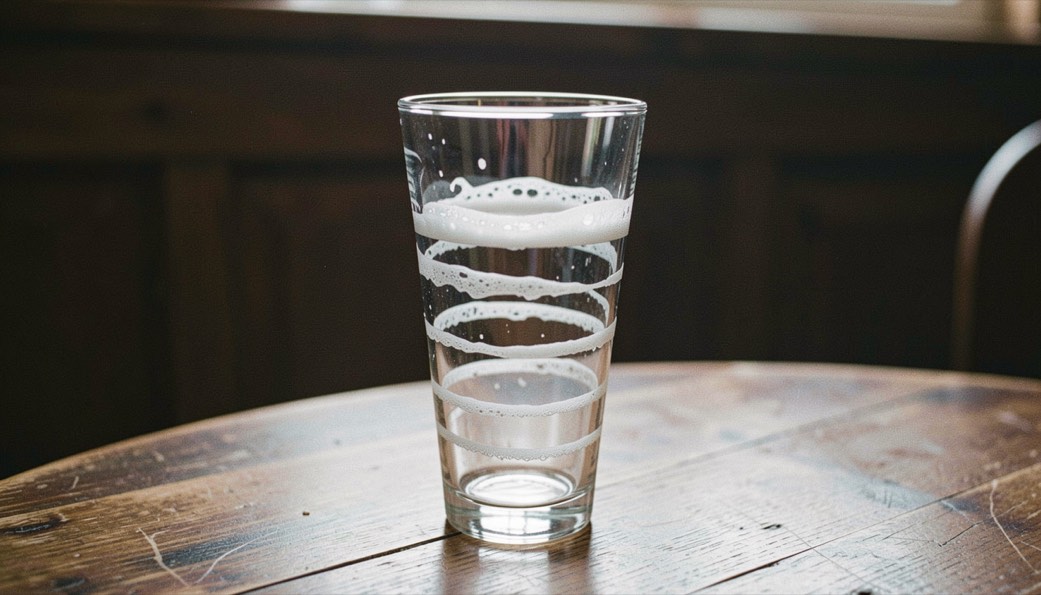
Lacing is the pattern of rings and webbing left on the inside wall as the head recedes. It needs two things at once: foam robust enough to leave a deposit, and a wall clean enough for it to stick to.
That makes it a genuinely useful signal, because it is the only one that reports on both variables at the same time. Even lacing in bands down the glass means a clean glass and a well built head. No lacing at all, on a beer that ought to produce it, means the glass has something on it.
Lacing also gives you a record of the drinking. Each ring is roughly where the head sat when you put the glass down, which is why a slowly drunk pint leaves a ladder and a quickly drunk one leaves almost nothing.
The pour
Carbon dioxide comes out of solution when it is given somewhere to go. A beer poured gently down the side of a glass, with the glass tilted the whole way, never releases much of it, and the result is a beer that looks calm and then goes flat in the glass because the gas is still dissolved in it and leaving slowly.
A beer poured at forty five degrees for the first half and then straight into the middle for the second half releases the gas where you want it, which is in the head rather than in your stomach. The head then feeds off the remaining dissolved gas for the rest of the drink.
Temperature is part of the same equation. Too cold and the carbon dioxide stays in solution, the head is thin and the aroma is muted. Too warm and it comes out all at once, on the way out of the bottle, and gushes. Most beers want somewhere between 6 and 12 degrees depending on style, and colder is not better.
The nitrogen case
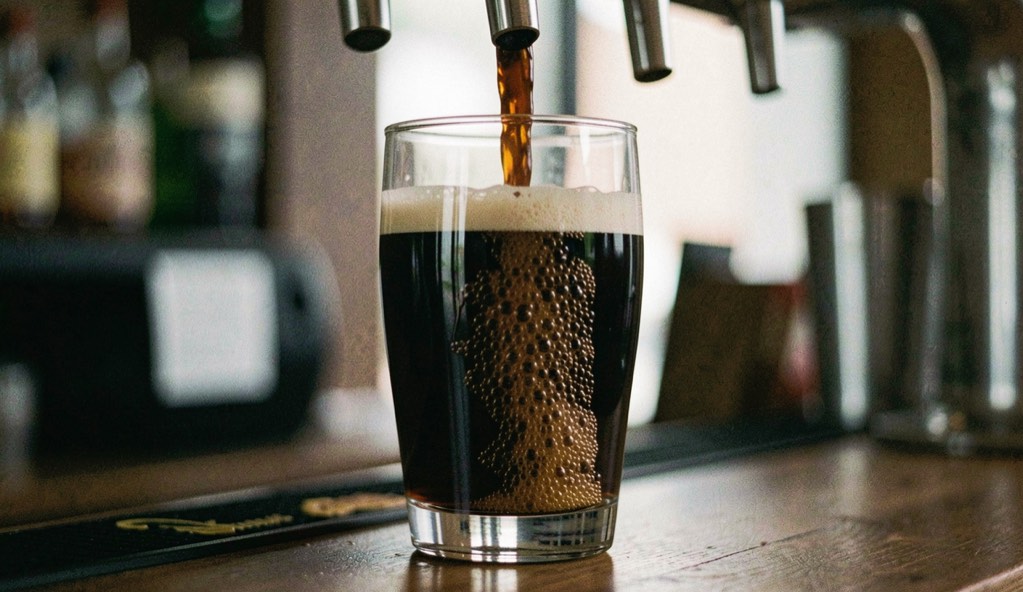
A nitro pour is not a stronger version of a normal one. Beers dispensed on a nitrogen blend, typically around 70 per cent nitrogen and 30 per cent carbon dioxide, are pushed through a restrictor plate with small holes that shears the gas into very fine bubbles.
Nitrogen is far less soluble in beer than carbon dioxide, so it comes out of solution readily and does not build the sharp carbonic bite that CO2 does. What you get is the cascade, then a dense, small bubbled, long lasting head that sits like a lid, and a beer underneath that tastes smoother largely because there is less dissolved gas in it.
Reading the head
- Thin or absent from the start: the pour. Too gentle, too tilted, or the beer is too cold.
- Good head that dies inside a minute: the glass. Something on the wall is breaking the films.
- Good head, no lacing: also the glass, and a milder version of the same problem.
- Enormous head that will not settle: the beer is too warm, or it has been shaken, or it is a bottle conditioned wheat beer behaving exactly as designed.
- Big loose bubbles rather than a fine dense foam: low protein, low hop content, or a beer that has been sitting open.
- Bubbles clinging to the inside wall below the surface: the glass again. Gas is nucleating on residue.
Why any of it matters
Beyond looking right, the head does two jobs. It holds the volatile aromatics, which is most of what you perceive as flavour, and it forms a physical cap that slows the beer beneath it from oxidising in the glass. A flat beer is not just a beer without foam; it is a beer whose aroma has already left.
Which is the practical case for owning the right glass, keeping it genuinely clean, and pouring properly. The shape side of that argument is in pilsner, tulip, nonic: reading a glass by its waist, and the one glass on the shelf that ignores every part of it, and gets away with it, is the subject of the beer boot, from barracks bet to bar trophy.
Filed under Beer culture. Published January 14, 2026.