How to drink from a beer boot without wearing it
Everyone who gets soaked by a glass boot gets soaked at the same moment and for the same reason. It is air, it is predictable, and one quarter turn of the wrist prevents it.
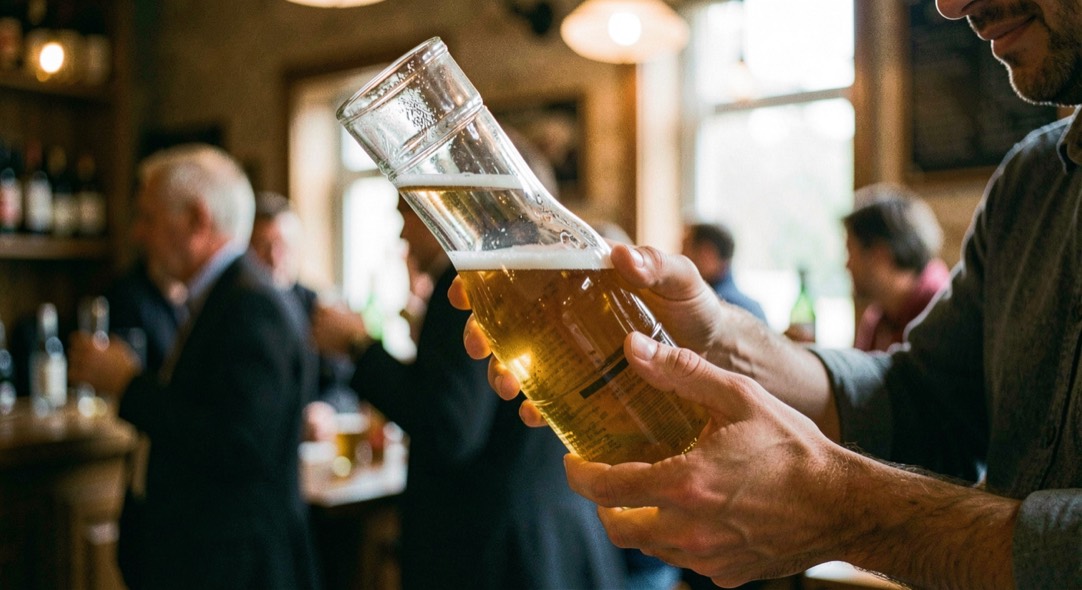
A glass boot is a badly behaved vessel by design, and the misbehaviour is concentrated in one place: the toe. Understand what happens in there and a two litre boot is no harder to drink from than a jug. Ignore it and you will take a slug of beer across the face somewhere around the halfway mark, in front of everybody, which is of course the reason boots are still made.
What actually happens
As beer leaves the boot, air has to get back in to replace it. In a normal glass the air comes in over the rim continuously and nothing dramatic occurs. In a boot, the toe is a closed pocket sticking out sideways from the bottom of a tall column of liquid.
While the toe points down or sideways, the beer drains steadily and the air travels up the leg. But the moment the toe rotates so it is pointing upward, the air trapped in it has somewhere to go: it breaks free as a single large bubble, rushes up the leg, and pushes a slug of beer out of the top all at once. That is the splash. It is not bad luck and it is not the boot being cursed.
The toe rule
Hold the boot so the toe points sideways, at ninety degrees to your face, for the whole of the drink. Left or right does not matter; commit to one. In that position the air pocket vents gradually along the side of the leg instead of gathering into one bubble.
Rotate the toe back to pointing down or toward you only at the very end, when there is too little beer left in the boot to do any harm. Some drinkers give the boot a quarter turn each time they raise it, alternating sides, which keeps the pocket unsettled and never lets a big bubble form.
How to hold it
- Two hands. One around the leg near the top, one supporting the ankle. A full two litre boot is around 2.5 kilograms with the glass, and a one handed grip on a wet boot is how boots get dropped.
- Rest the toe against your forearm rather than letting it hang free. It steadies the whole thing and it stops the toe swinging round by accident.
- Drink in a steady stream rather than in gulps. Gulping means stopping, and stopping means the liquid surges back down the leg and shoves air into the toe.
Filling it
Pour with the boot tilted, toe pointing down and to the side, and start the beer against the inside of the leg. If you pour straight into an upright boot, the beer hits the ankle and foams, and you end up with a pocket of foam sitting in the toe that neither drains nor drinks.
A two litre boot takes about three and a half British pints. A one litre boot is the sensible size for a table of four to share, and a half litre boot is a novelty glass that behaves like an awkward stein.
Passing etiquette
The boot is a shared object, so it comes with table customs. The ones that travel are worth agreeing out loud before the first drink, because every group has met a different version.
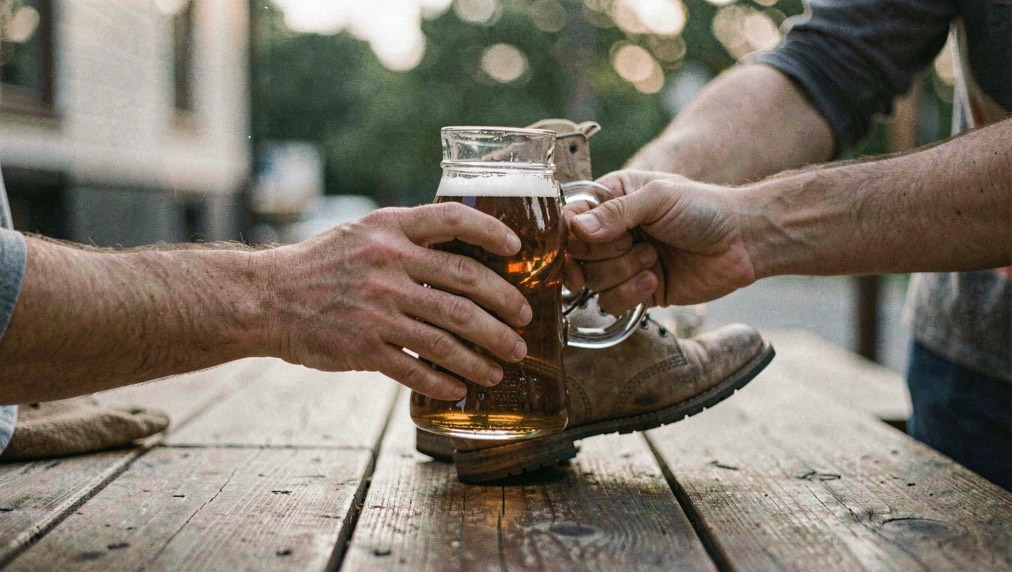
- Pass with the toe pointing at the next drinker, so they receive it in the correct orientation and have to make a decision about it.
- The drinker who releases the first air bubble buys or fills the next boot. This is the common form of the wager and it is the reason the toe rule is worth knowing.
- The drinker who empties the boot is exempt from the round. Finishing is a job, not a prize.
- Anyone who wants to sit the boot out fills their own glass and stays in the round. The rules on this site all work with water or a soft drink, and a boot is no exception.
Cleaning the thing
A boot is the hardest glass in the house to clean, because the toe is a right angled dead end that no normal brush enters. A long handled brush with a flexible neck, bent to about ninety degrees, is the only tool that reaches it. Wash it the same day; anything left in a toe overnight dries into a ring that then needs soaking.
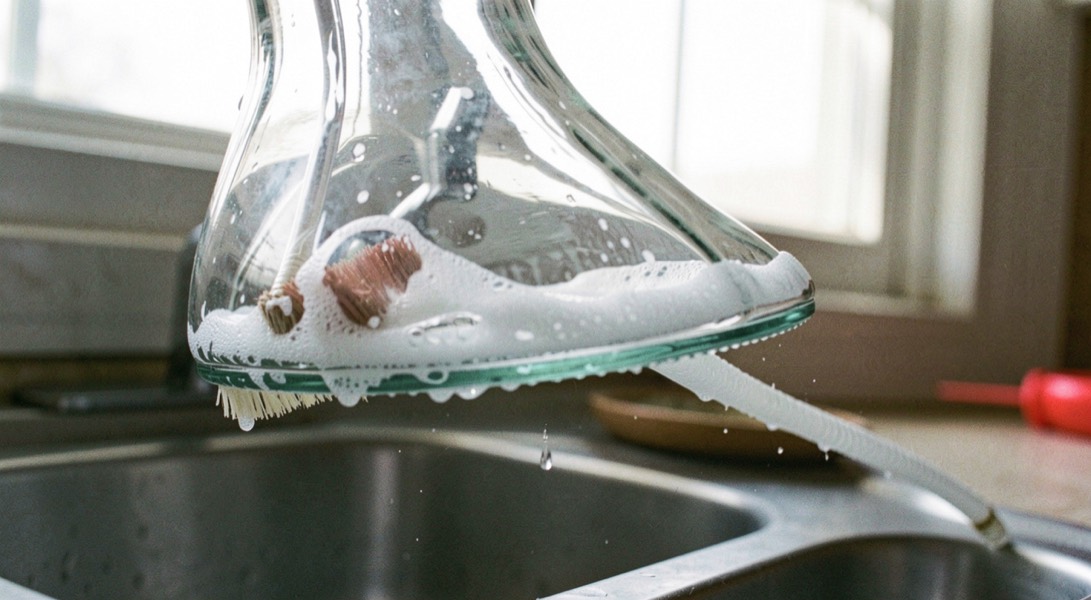
Drying is the second problem. Stood upright, a boot never dries, because the toe holds a puddle and the air does not circulate. Store it on its side with the toe slightly downhill, or upside down on a rack with the opening clear. A boot that smells stale has water in the toe, every time.
And use no rinse aid, for the same reason as every other beer glass in the house: the residue is a surfactant and it flattens the head. The full washing routine, including the test that tells you whether a glass is genuinely clean, is in washing and storing glassware so the head survives.
Where the shape came from
The boot is the only glass on a bar shelf that ignores every principle of glass design at once: it has no useful waist, it traps aroma nowhere, and it puts the drinker's hand all over the beer. It survives because of what it is for, which is a shared object with a story attached, and that story is in the beer boot, from barracks bet to bar trophy.
If you want the opposite of a boot, the shelf has plenty: the stems, cones and bulges that all have a reason, set out in pilsner, tulip, nonic: reading a glass by its waist. And if the boot is coming out at a table that is also playing cards, put it somewhere it cannot be knocked, because a boot on its side empties completely in about four seconds.
Filed under Glassware. Published March 19, 2026.